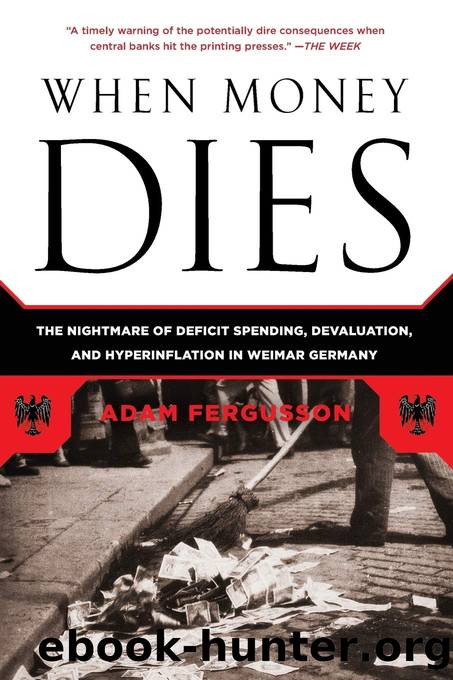
When Money Dies: The Nightmare of Deficit Spending, Devaluation, and Hyperinflation in Weimar Germany by Adam Fergusson
Author:Adam Fergusson [Fergusson, Adam]
Language: eng
Format: epub
Tags: Business & Economics, History, Economic History, Politics, Germany, Social History, Europe
ISBN: 9781586489953
Google: -6I4DgAAQBAJ
Amazon: 1586489941
Publisher: Hachette UK
Published: 2010-10-12T21:03:36.704000+00:00
Hemingway recorded for the Toronto Daily Star that Champagne then cost 38,000 marks a bottle, luncheon 3,500 marks, a sandwich 900 marks, and beer 350 marks a stein.
I remembered that last July I stayed at a de luxe hotel with Mrs Hemingway for 600 marks a day. âSure,â the waiter went on, âI read the French papers. Germany debases her money to cheat the Allies. But what do I get out of it?â
The answer was that the waiter got nothing out of inflation, and - apart from relieving itself of a further minute proportion of the remaining minute fraction of the national debt - nor now did the Exchequer. There were those, however, who were doing better than ever. A currency speculator who borrowed from the Reichsbank on January 1, 1923, enough paper marks (about 1,980 million) to buy 100,000 dollars, and on April 1 sold enough dollars (about 80,000) to repay the bank, and who again borrowed the equivalent of 100,000 dollars and continued thus until the end of May, could have made the equivalent of a quarter of a million dollars at the expense of the acceptors of pure marks. His problem then, of course, was in what form to keep his profits: if they were in marks, they would evaporate before his eyes.
That evaporation was inevitable. In March, April and May the governmentâs income was a mere 30 per cent of its expenditure; and during May the working classes actually paid more to the Reich in tax than the assessed tax payers of the higher social classes, for the reason that whereas the former could be tapped at source, the others had to fill in returns which were long out of date by the time the administrative machine could deal with them. Between May Day and May 31 the mark fell from 220,000 to 320,000 to the pound. The First of June was celebrated with the issue of the first five-million-mark note.
Speculation in currency was in no way the exclusive domain of the financially informed. Anyone - banker, politician, businessman or workman - who observed that there were easier ways of keeping oneâs head above water than the now very problematic one of working for it was ready to indulge as opportunity offered. It was computed that well over a million Germans in early 1923 were engaged in exchange speculation. Their dealings took place mainly through the so-called Winkelbankiers, the back-street operators who had sprung up with inflation and, battening on an unhealthy economy, made a living entirely through taking advantage of the difference in the buying and selling prices of foreign currencies. Although they were not even members of the Bourse, they played a significant part in determining the daily rate of exchange - and, indeed, to the arbitrage machinations of the Winkelbankiers was attributed the fact that Berlin invariably closed at a lower rate than New York.
By the end of May 1923 no single reform, possibly no half dozen measures, would have been enough to avert ultimate disaster.
Download
This site does not store any files on its server. We only index and link to content provided by other sites. Please contact the content providers to delete copyright contents if any and email us, we'll remove relevant links or contents immediately.
Personalized inhaled bacteriophage therapy for treatment of multidrug-resistant Pseudomonas aeruginosa in cystic fibrosis by unknow(215039)
CONSORT 2025 statement: updated guideline for reporting randomized trials by unknow(102522)
Critical evaluation of the ProfiLER-02 study design and outcomes by Vivek Subbiah & Razelle Kurzrock(102048)
Cardiac gene therapy makes a comeback by Oliver J. Müller & Susanne Hille & Anca Kliesow Remes(101839)
Whisky: Malt Whiskies of Scotland (Collins Little Books) by dominic roskrow(74622)
Unveiling the design rules for tunable emission in graphene quantum dots: A high-throughput TDDFT and machine learning perspective by Şener Özönder & Mustafa Coşkun Özdemir & Caner Ünlü(51003)
A yeast-based oral therapeutic delivers immune checkpoint inhibitors to reduce intestinal tumor burden by unknow(40375)
Covalent hitchhikers guide proteins to the nucleus by Alexander F. Russell & Madeline F. Currie & Champak Chatterjee(40297)
Meet the Authors: Christopher R. Mansfield and Emily R. Derbyshire by Christopher R. Mansfield & Emily R. Derbyshire(40210)
Alkaline-earth metals promote propane dehydrogenation with carbon dioxide through geometric effects: Altering the reaction pathway by unknow(32815)
Induced iron vacancies boosting FeOOH loaded on sustainable Fenton-like collagen fiber membrane for efficient removal of emerging contaminants by unknow(32612)
Efficient electric-field-assisted photochemical conversion of methane to n-propanol exclusively over penetrated TiO2Ti hollow fibers by Guanghui Feng(32532)
Bi2SiO5 nanosheets as piezo-photocatalyst for efficient degradation of 2,4-Dichlorophenol by Hangyu Shi & Yifu Li & Lishan Zhang & Guoguan Liu & Qian Zhang & Xuan Ru & Shan Zhong(32470)
A novel NDIPTA organic heterojunction photocatalyst with built-in electric field for efficient hydrogen production by Jiahui Yang & Baojun Ma & Yongfa Zhu(32444)
Enhanced conversion of methane to liquid-phase oxygenates via hollow ferrite nanotube@horseradish peroxidase based photoenzymatic catalysis by Jun Duan & Shiying Fan & Xinyong Li & Shaomin Liu(32406)
Ordered macroporous superstructure of defective carbon adorned with tiny cobalt sulfide for selective electrocatalytic hydrogenation of cinnamaldehyde by Xiao-Shi Yuan & Sheng-Hua Zhou & San-Mei Wang & Wenbo Wei & Xiaofang Li & Xin-Tao Wu & Qi-Long Zhu(32335)
What's Done in Darkness by Kayla Perrin(27262)
Topological analysis of non-conjugated ethylene oxide cored dendrimers decorated with tetraphenylethylene: Insights from degree-based descriptors using the polynomial approach by A Theertha Nair & D Antony Xavier & Annmaria Baby & S Akhila(26632)
Investigation of mechanical and self-healing properties of hydroxyl-terminated polybutadiene functionalized with 2-ureido-4-pyrimidinone by Mohsen Kazazi & Mehran Hayaty & Ali Mousaviazar(26556)
